
My intention with this post is to share a personal journey on breastfeeding, which started as an uphill battle after a 2 day stint in the NICU and things I learned along the way.
When I was still pregnant, I started educating myself by attending local La Leche League meetings, watching videos on hand expression (you can extract colostrum in late pregnancy but after two feeble attempts, I gave up) and getting my nips assessed virtually by a Lactation Consultant (LC) to identify any issues going in (there weren’t any). I also hired a birth doula who would help us navigate golden hour among other things.
After a very blessed and issue free pregnancy and a very strong and active baby in utero, the last thing I anticipated was a NICU baby. Yet after three loooong days and nights of labour and an initial AGPAR score of 9/10, that’s exactly where Sienna ended up (blame it on the meconium). I only had her for 1 minute before they whisked her away. So long, golden hour.
How the NICU negatively impacted breastfeeding
I was beyond exhausted after that marathon birth. In the aftermath, it hurt to sit, walk, lean back and go to the bathroom thanks to my tier 2 stitches. Trying to shuttle from our room to the NICU every three hours was almost more than I could manage. It didn’t dawn on me to start pumping until two days later when they were thankfully ready to release Sienna.
Up until then, she was on IV fluids, a pacifier (a big no-no in die hard breastfeeding circles) and sugar water (which I was not going to have access to). I started to panic when I got zero milk from pumping with the Medela Symphony.
It took a couple of young mama nurses who literally squeezed my boobs to get that stubborn colostrum out. And when I tried to breastfeed Sienna, she would open her mouth wide like a fish, without suckling or moving her lips. That was not going to make my milk come in!
But what broke my spirit fully, was when we tried to force the issue. A couple of nurses were shoving and forcing Sienna to my boobs, to the point where she would start crying as she approached my naked chest. And then I started crying because it felt like my body repulsed her. An unsafe haven. If breastfeeding was so natural, why were we struggling so much?
The hospital did not have a Lactation Consultant on staff (check if your birthing hospital does) and I could not get one to visit me until we were discharged and at home. After being warned that babies prefer fast flow bottles to boobs, it felt like our window was shrinking.
How an osteopath reset me nervous system and got Sienna to latch 1 week later
Five or six days after Sienna’s birth, we finally got a local LC over – while she helped us latch in that visit, I could not replicate it with Sienna in any position thereafter (cradle, side lying etc.). The LC did diagnose a tight frenulum, which is basically a posterior tongue tie but suggested I follow up with a pediatric expert to confirm. I did not have it in me to follow up.
After some googling and IRL mom chats, I learned that birth trauma can play a role in tight frenulums and that chiro or osteo treatments on the baby can release facial tension. This googling lead me to my fairy Godfather Mark, the manual therapist / pseudo osteo.
He basically diagnosed that Sienna’s anatomy was not an issue, but rather my being in fight or flight mode for days on end was. He said we needed to bring the temperature down in my body to create a sense of calm for Sienna at the breast. I got a same day appointment and by the end of that 1.5 hours, Sienna latched for the very first time on site and continued to ever since. 10/10 recommend.
FIVE tactics that DID increase milk supply
Mark got us on the ramp, but my friend Lisa, a recent LC grad, got us climbing, thanks to the plan below:
- Focus on stimulation vs. output – it was demoralizing to pump for the first three weeks and get so little output, 5 to 15 mls total for both boobs when baby was meant to be drinking 30 – 60 MLs per feed. I also found it hard to pump every 2.5 hours especially overnight (I’d go 5 or 6 hours sometimes if baby slept). I pumped every 3 to 4 hours and lo and behold it slowly and steadily increased to “just enough”
- Milk aplenty supplement – this did wonders and did not have ingredients that caused gas for baby, which we were struggling with separately
- Frequent check-ins with my virtual LC – giving little updates by text every day or two, with troubleshooting calls and getting encouragement was vital. Seriously, call Lisa! She was also able to assess Sienna’s latch and help with positioning over video.
- Eating, drinking and sleeping enough – my full time job outside of breastfeeding was eating, resting and staying hydrated including an Indian dill seed and anise drink courtesy of Tik Tok. I heavily relied on grandparents and hubby for support with house stuff
- Preemie nipples on Dr. Brown’s bottles – these nipples encouraged active suckling and made the bottle less competitive with my flow (I had to replace the ones that came with the narrow neck bottles themselves)
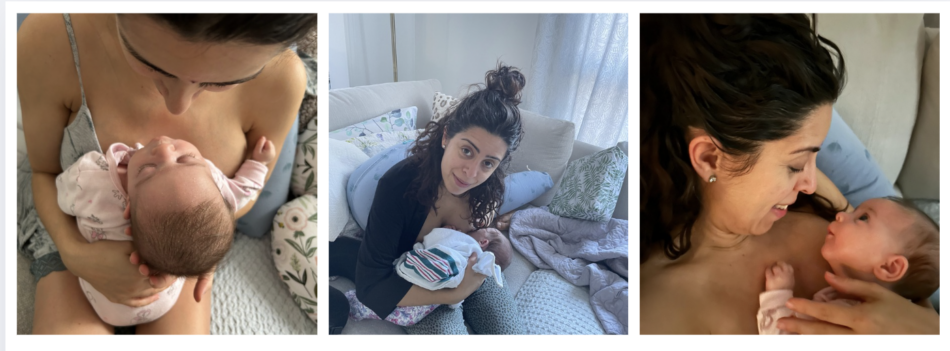
What breastfeeding looked like in the early days
TWO tactics that did NOT increase milk supply
While everyone is different, the below did not help ramp up to exclusive breastfeeding
- Tube feeding – once Sienna was able to latch, the local LC returned to show us how to tube feed, which essentially has the baby stimulate your nipple by sucking on it AND a thin tube, while the tube is inserted into a cup with formula or milk in it. The idea was that baby would stimulate the nipple while getting enough milk intake from another source. While it worked with the LC present, Sienna always knew when we tried to use the tube, and I think it reminded her of the NICU trauma. She hated it!
- Lactation cookies – I bought the $20 brewer’s yeast on Amazon but ended up cutting dairy from my diet to assist Sienna’s digestive upset and so those buttery cookies were a no-go
So, what kept me going those first 6 weeks and beyond?
To be honest, in those first few weeks I struggled to feel connected to Sienna the way I had when she was in the womb. It felt like other caregivers were preferred or more capable of burping, holding, napping and diapering her.
- Breastfeeding was the only thing others could not do for her. It was the only thing that made me feel needed and like her mom. I’ll admit these were not the healthiest reasons to breast feed, but very motivating, nonetheless.
- On a related note, breastfeeding also gave me uninterrupted time with her alone.
- Cow’s milk did not seem to agree with Sienna’s body. Her skin was full of acne, she had silent reflux and her poops were green until we were able to cut formula, plus cow’s milk from my diet. This made my initial plan of combination feeding feel impossible
- Lastly, because I fought so hard to get my supply in, I didn’t want to give up breastfeeding prematurely, even though at times the mental health cost was quite high
My initial plan was to combination feed with breast and formula and if I were ever to do this again, I would try to make that happen. I believe fed is best and every mama has the right to choose how to feed her baby based on what is best for her and the whole family.
And there you have it, our topsy turvy journey to breastfeeding after a rough, unpredictable start. I have lots more to share on the pros and cons of exclusive breastfeeding and more on tongue ties in upcoming posts.
So, tell me, do you have any more breastfeeding ramp up tips to add? What curve balls, if any, did your birthing journey gift you? In hindsight, what did you learn from your baby’s feeding journey?
Lots of love,
Vanessa xo