
I never expected to exclusively breastfeed. My plan going in was to combination feed with breast and bottle to give us the best of all worlds.
I heard stories about milk supply not coming in or declining, babies who preferred bottles over boobies and the exact opposite: babies tethered to their mamas who went on hunger strikes when she wasn’t around. Neither extreme sounded great to me! I shared about my uphill battle to ramp up to exclusive breastfeeding in a previous post.
And while it can feel like breastfeeding is the holy grail, I’m here to share what I liked and didn’t like about breastfeeding for 16 months and counting, in the hopes that it may help prepare and/or comfort you on your baby’s feeding journey. It’s not all sunshine & rainbows! Now let’s dive into the question: “should I exclusively breastfeed my baby?”
The Pros of exclusive breastfeeding
- Being able to control for diet and help baby’s digestion – though this was also a double-edged sword (see cons) – when dairy seemed to not agree with Sienna, I was able to fully control this with breastfeeding by cutting things out of my diet
- Always available on-the-go and on demand – easy to comfort baby 24/7, no muss, no fuss, no gear, no waiting, no clean up
- Not having to pump –I just could not fit pumping into my routine as I was already spending 30 to 60 minutes a breast feed with Sienna (likely due to her poor latch) every 2.5 to 4 hours.
- Plus, I routinely forgot pumped milk in the fridge for days on end and had to toss it #tragic.
- I also forgot to clean pump parts until I needed to use them in the middle of the night #doh.
- We also had to remember to sterilize the bottles especially during 100% formula days.
- In the early days when we had to warm milk for Sienna during colicky phases, we would trip over each other and do head stands waiting for the 3-minute timer to be up – an eternity!
- Nothing hurt more than tossing out a full bottle of pumped milk that touched the baby’s lips once but wasn’t what the crying was about. I found it personally stressful and like more hard work to pump.
- Lots of health benefits for mama like reducing certain cancers, releasing oxytocin which helps make you both sleepy etc.
- Lots of health benefits for baby – breast milk changes composition based on day or night and baby’s saliva, as well as their age
- It’s free vs. formula – see below section!
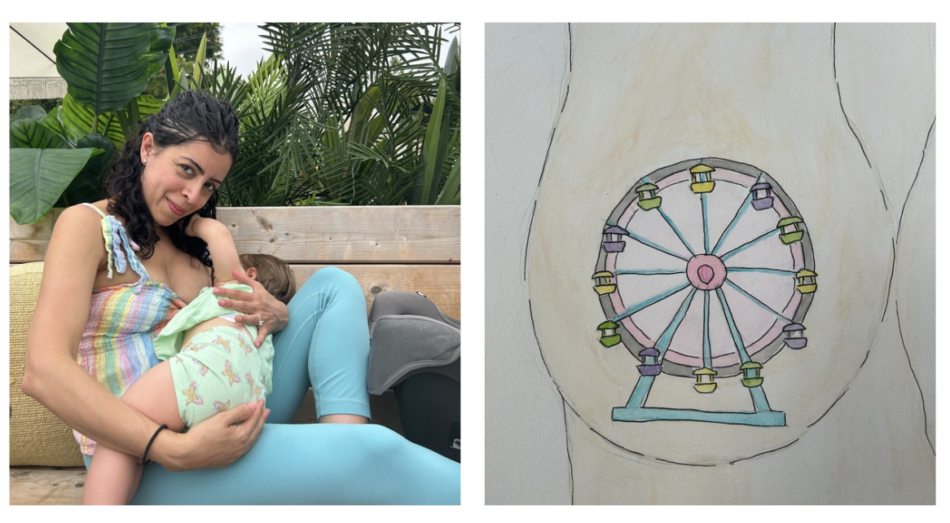
Left: an upbeat moment of breastfeeding. Right: my attempt at a watercolour illustration of the ups and downs of breastfeeding with a ferris wheel at the nip
What I learned About Formula Feeding
- I didn’t know that liquid ready to feed formulations are safer for newborns (I had bought powder before Sienna’s birth)
- If your baby starts on formula in the hospital, they likely will not use alternative formula that you bring because it’s a liability issue
- You can test how your baby reacts to a new formula by buying lower quantities off of Facebook marketplace, especially for European brands which can cost $9+ per single bottle, with bulk discounts thereafter
- Waste: Once we were doing 50% formula and 50% breastmilk (and onwards towards 100%), we weren’t using even half a bottle of liquid ready to feed formula a day and because we chose the HIPP brand (more costly but cleaner ingredients), we were throwing out a lot of unused formula that never made its way into a bottle (24 hour usage period from opening)
- Even with the powder containers of formula, you need to use within 3 weeks of opening or else toss and since I was looking for goat milk formulations, the cost was also quite high to only use 1 or 2 bottles of formula a day (in theory)
- I also didn’t know that Baby Brezza formula pro machines existed, which act like espresso machines for powder formula, perfectly mixing it to avoid clumps (choking hazard). They can be purchased on Facebook marketplace at a decent discount. The minimum quantity for the machine to output is 60 ML, which babies hit around 1 to 2 months of age
- There are also low cost solutions to warm formula on-the-go like the Tommee Tippee container
- Pace bottle feeding is helpful for babies prone to reflux and burping a baby regularly is helpful, even if breastfed
The Cons of exclusive breastfeeding
Some mamas are a bit shy about breastfeeding around others and end up staying home a bit more around feeding times to avoid the discomfort. For me personally, after what felt like 100 people attended Sienna’s birth, I got over any shyness breastfeeding around other (a little swaddle blanket does the trick). Not a con, but a consideration!
- Constant questions from family members on whether baby is “getting enough.” The reality is you just don’t know how much they are getting. I could not load Sienna up with a big bottle before bed or long car rides. I was also always paranoid my supply would vanish due to our slow start, but wet diapers, weight gain and growth curves tell the story of “enough”.
- Constant questions from family members on whether my milk was causing her digestive discomfort. Sienna had this weird gulping issue that seemed to wake her from naps and bedtime (silent reflux). Her poops were green for a while in the beginning. Then her poops slowed down to once in 11 days (it was my iron supplement). I cut cow, goat and sheep’s milk for awhile and then avoided all gassy foods for a bit. It is not a great feeling to know all the sacrifice and work of breastfeeding may not be worth the cost.
- Tethered to baby around the clock – no split shifts overnight or mama time out of the house, given I didn’t pump much and formula was a no go. Freedom is a big personal value of mine, and exclusive breastfeeding did not feel freeing.
- Baby can fall asleep at the breast – creating a snacker vs. full meal approach, meaning you need to feed more frequently and it messes with the wake and sleep windows (babies don’t nap as well from hunger). We fell into this trap with Sienna and didn’t know how to resolve before she out grew it
- Related: Breastfeeding can compromise baby sleeping well and independently overnight. Breastfeeding to sleep became the main sleep association for Sienna day or night. We did not co-sleep and we did hire a sleep consultant for a gentle approach to teach her another way, but it did not work for us. That being said, I do know breastfeeding mamas whose babies sleep well!
- Can be boring to be stuck in a chair feeding for 5+ hours a day, especially if they have a poor latch. Bottle feeding is a faster process. In hindsight, I should have addressed tongue tie sooner!
- Costly treatments to avoid mastitis – I had to spend money multiple times on blocked duct ultrasound therapy and breast massage to avoid mastitis, both before and after the tongue tie release. That being said, I never got mastitis!
- Needing to learn to wind breastfeeding down and wean – a mountain I have yet to attempt but need to
So, was it worth it? Would we exclusively breastfeed again?
It’s such a personal choice and based on your own family values and whatever unexpected cards are dealt post birth.
While I do enjoy breastfeeding, it has come at a personal cost of freedom, sleep and mental wellbeing especially in the beginning (first 3 to 6 months). IF we were to do this again, I’d try harder to combination feed and use hypoallergenic formula early on or right away to mitigate dairy intolerance issues (though they say avoidance of certain allergens can cause sensitivities too). I’d split the night shift with a bottle of pumped milk or formula to get better sleep early on for both parents.
Breastfeeding & Pumping Resource Links
- Paced bottle technique – this helps keep the flow reasonable
- Preemie nipples for Dr. browns bottles – this keeps the flow of milk slow out of the bottle to make it less competitive with breastfeeding, which requires more work; na
- La Leche League Community – branches across Canada, volunteer run and often have doulas and midwives in the mix, plus knowledgeable mamas and lots of online PDF resources, free virtual library, in person events, virtual events + more
- Kellymom Online Resource – vetted information on many topics
- Genuine Lactation – does low-cost virtual consultations to measure your nipples for proper flange sizing for pumpts (often women need to size down smaller than flanges that come with your pump). She also has a great wearable pump guide and helpful YouTube videos. I could not get local LC’s to measure me – pro tip, your nipples should not get supersized after using your pump and your areola should not get sucked in.
- Breast Pump Review Community – New Little Life has a great YouTube library of pump reviews but she also has a free Facebook community with very experienced pumpers in the US, who give invaluable personal advice on choosing a pump. I spun on this decision so hard and ultimately chose the Ardo pump, which was decently similar to the Medela Symphony hospital grade pump rental I used.
- Dairy Free Breastfeeding Community – a friend of mine referred me to this Facebook group, which was a little intense but when I was trying to help Sienna’s early digestive issues and green poops I did find some resources here helpful
So, tell me – did I miss any pros or cons? I would love to know how your feeding journeys went – any lessons learned? Regrets? Loves? Hates?
All my love,
Vanessa xo